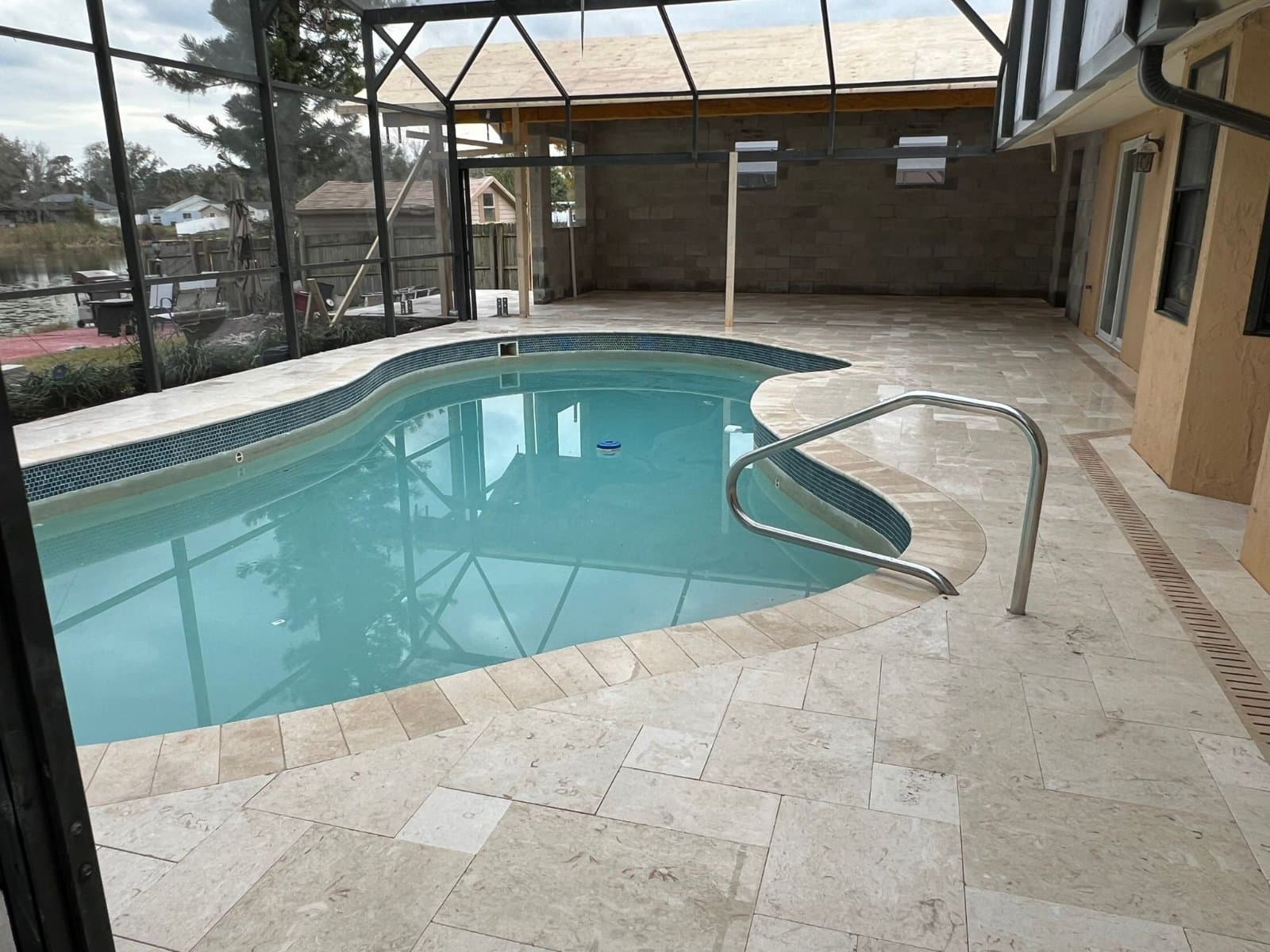
Paver Work Across Every Seminole County City
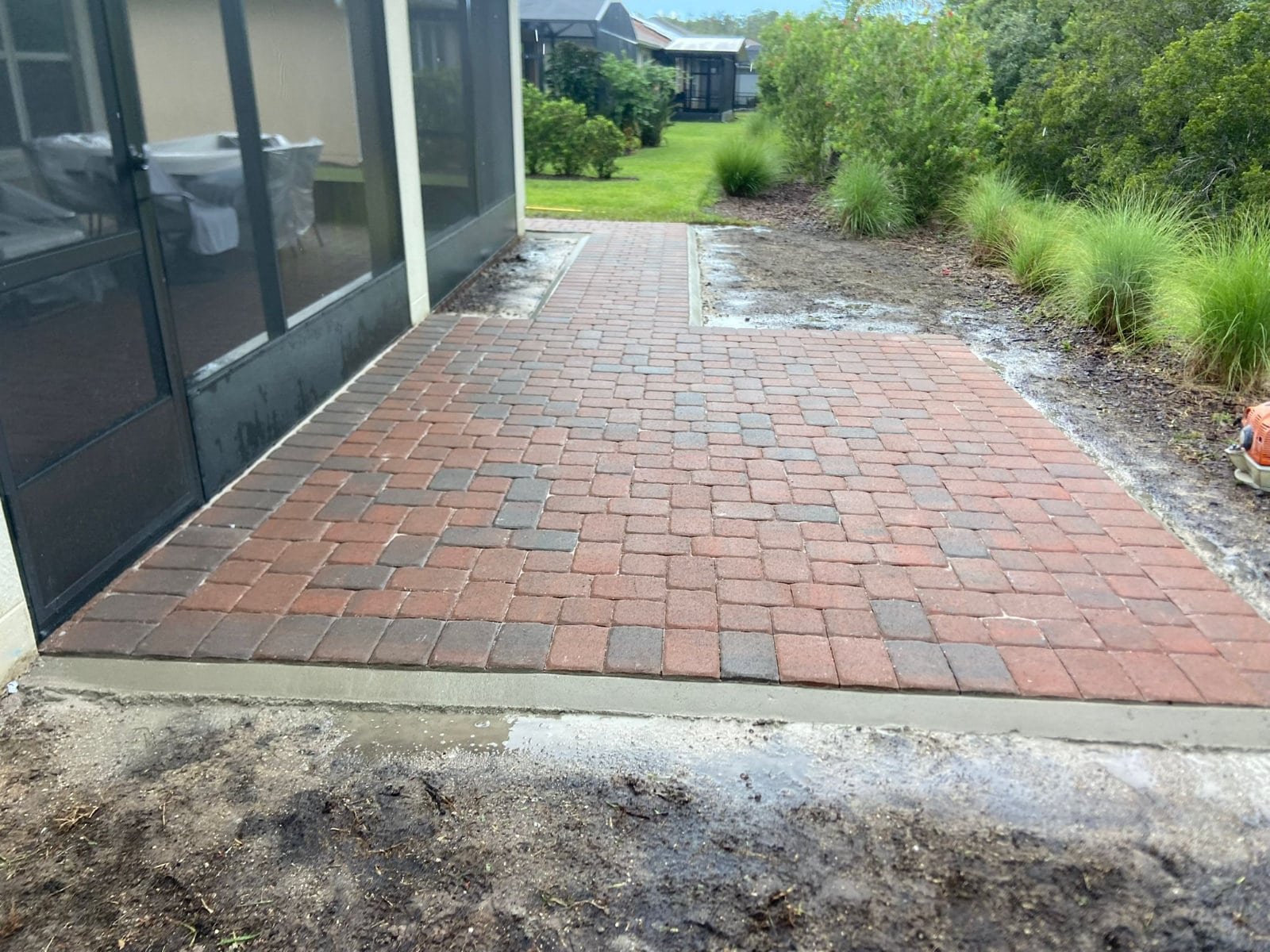
Seminole County packs seven incorporated cities into a compact footprint: Sanford, Lake Mary, Longwood, Altamonte Springs, Casselberry, Winter Springs and Oviedo. Around and between them sit large unincorporated pockets, including well known planned communities like Heathrow, Alaqua Lakes, Magnolia Plantation and Sanctuary, plus Live Oak Reserve out in the Oviedo area.
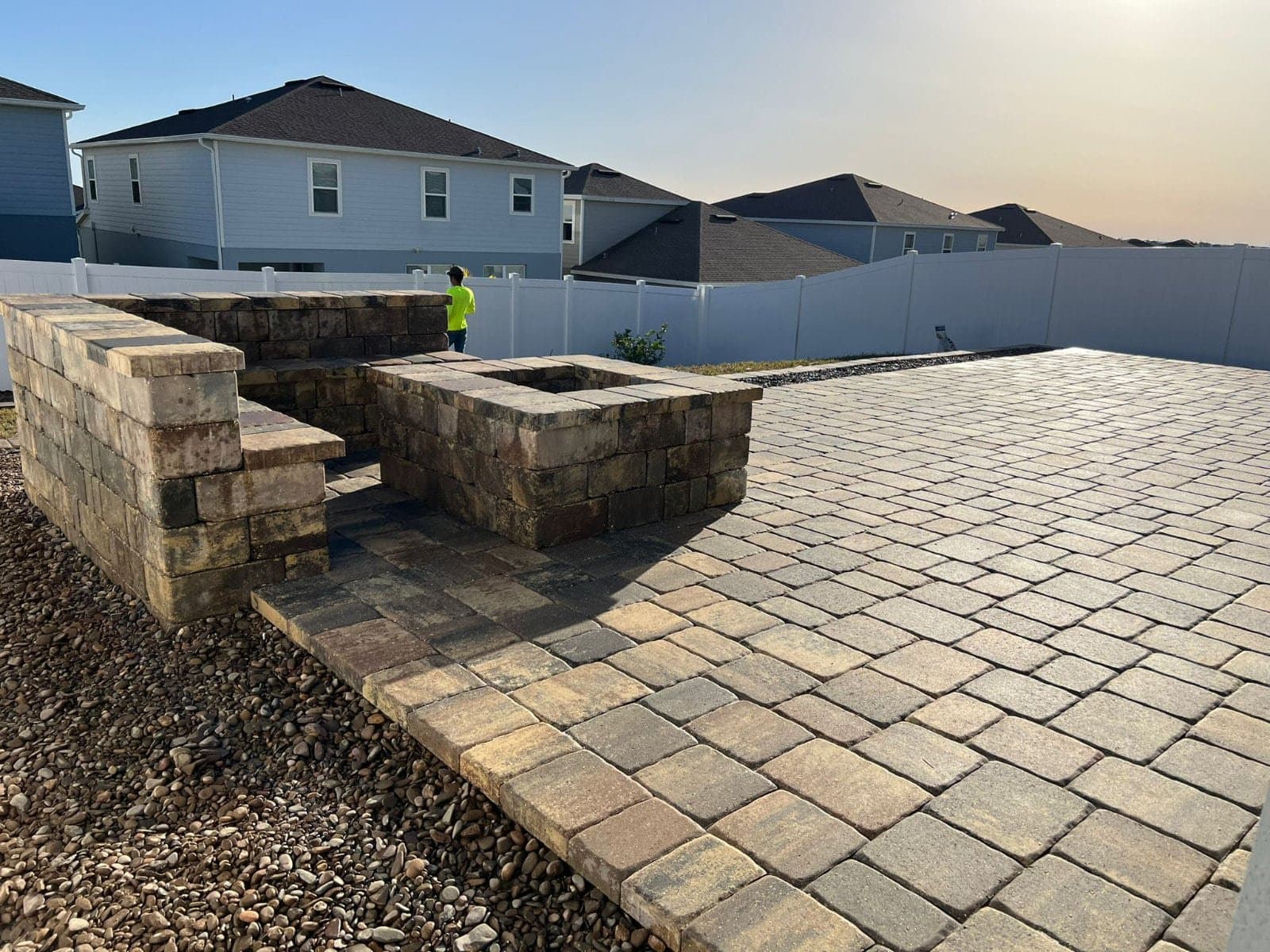
We install brick pavers in all of it. Most of what homeowners here call about falls into a short list:
- Paver patios, either a first patio on bare grass or a replacement for a cracked concrete slab.
- Paver driveways and aprons, including the section that meets the road.
- Pool decks, where surface temperature, slip resistance and drainage all matter more than looks.
- Walkways, entries and front steps, usually the cheapest project with the biggest visual payoff.
- Retaining walls and elevated paver decks, for lots that slope or sit low.
- Outdoor kitchens and grill surrounds built into the paver field.
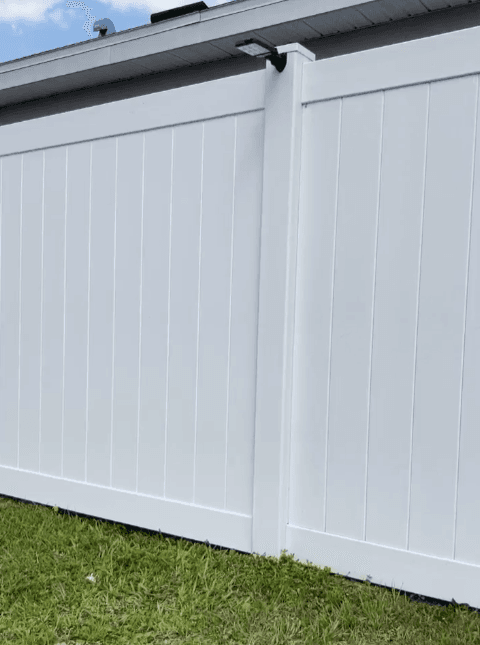
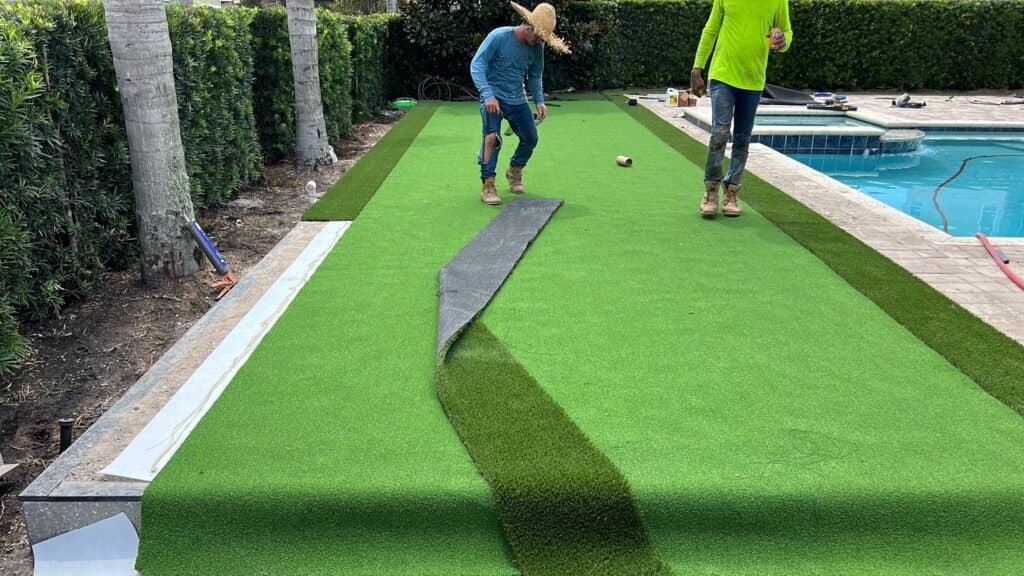
All of that lives under one service page: brick paver installation. We also do fence installation, artificial turf installation and ongoing outdoor maintenance plans, which matters here because a lot of Seminole backyard projects are two or three of those at once. A pool deck usually comes with a pool barrier. A turf lawn usually comes with a paver border. Doing them on one schedule, with one crew sequence, saves you from three contractors blaming each other over the same twenty feet of dirt.
One thing worth knowing before you call anyone: we handle every permit and HOA submittal as part of the quote. That is not an add on line item and it is not something we hand back to you as homework.
What Actually Drives the Price of a Paver Project Here
Paver quotes in Central Florida vary more than people expect, and the variation is almost never about the paver itself. Here is what moves the number, roughly in order of impact.
Square footage, but not linearly
Bigger areas get cheaper per square foot, because mobilization, excavation equipment and crew setup are close to fixed. A 200 square foot walkway and a 900 square foot patio do not cost 4.5 times apart. If you are on the fence about extending a patio, price both sizes at once. The incremental cost of the extra area is usually the best value in the whole quote.
What is already there
Bare grass is the cheapest starting point. Existing concrete is the most expensive, because it has to be broken up, hauled off and disposed of before anything else happens. Some contractors will offer to lay pavers directly over sound concrete. That can work on a covered porch. On an open patio in Central Florida it often does not, because you have just raised the finished height and given water a new place to sit.
Excavation depth and base thickness
A pedestrian patio and a driveway that carries a truck do not get the same base. Driveways need more compacted base, which means more digging, more material and more haul off. If a driveway quote and a patio quote come in at the same price per square foot, ask what base depth each one assumes.
Grading and drainage work
This is the wildcard on Seminole lots, and it deserves its own section below.
Access
Crews need to get a skid steer and material to the work area. A wide side yard is easy. A narrow gate between the house and a fence, a mature oak with surface roots, or a slope up from the street all mean more hand work and more hours.
Material and pattern
Paver style, thickness and color affect cost, and so does layout. A running bond is fast. Herringbone at 45 degrees generates far more cuts along every edge, and cuts are labor. Borders in a contrasting color add cutting too. None of this is a reason to avoid the pattern you want, but it explains why two quotes for the same square footage can differ.
Permit and inspection scope
A patio in a back yard and a driveway that ties into a county road are different regulatory animals. See the driveway section below.
Base Prep and Drainage: The Part You Never See
Nearly every failed paver install in Central Florida is a base or drainage failure wearing a cosmetic disguise. Sunken spots, wavy lines, a dip that holds a puddle for two days, edges that creep outward: those are almost never the pavers going bad. Pavers are individual units. They go where the ground under them goes.
Two local realities make base work non negotiable in Seminole County.
The rainy season is intense and predictable. From June through September, Central Florida runs a daily pattern of afternoon thunderstorms, typically between 3 p.m. and 6 p.m., and the region takes on roughly seven inches of rain a month in that stretch, against about three inches a month from October through May. That is more than double the water load, arriving in short violent bursts rather than gentle soaking. A surface that drains adequately in March can pond in July.
Water that has nowhere to go finds the path of least resistance, which is usually the base under your new patio. It washes out fines, creates voids, and the pavers settle into them.
Seminole County has a serious flooding history. Hurricane Ian in September 2022 caused historic flooding across the county, with roughly $340 million in estimated damage. Neighborhoods along the St. Johns River, the Little Wekiva River and Lake Harney went under, and more than 80 roads stayed flooded for as long as 40 days. Forty days is not a storm event. That is a groundwater event.
If your property is anywhere near that kind of low ground, the paver conversation has to start with where the water goes, not with what color the stone is. In practice that means a few things get decided before installation:
- Pitch. The finished surface has to slope away from the house at a consistent fall. Flat looks better in a photograph and fails in a storm.
- Where the runoff lands. A new impermeable patio does not delete water, it relocates it. If the discharge point is your neighbor's yard or your own foundation, the design is wrong.
- Whether the base needs help. Some lots need a drain line, a channel drain at a threshold, or a permeable joint approach rather than a standard sand set.
- Compaction in lifts. Base material compacted in thin layers holds. Base dumped thick and rolled once does not, and you will not be able to tell the difference on install day.
Ask any contractor bidding your job to say out loud where the water goes. If the answer is vague, you have learned something useful about the quote.
Paver Driveways and the Seminole County Driveway Permit
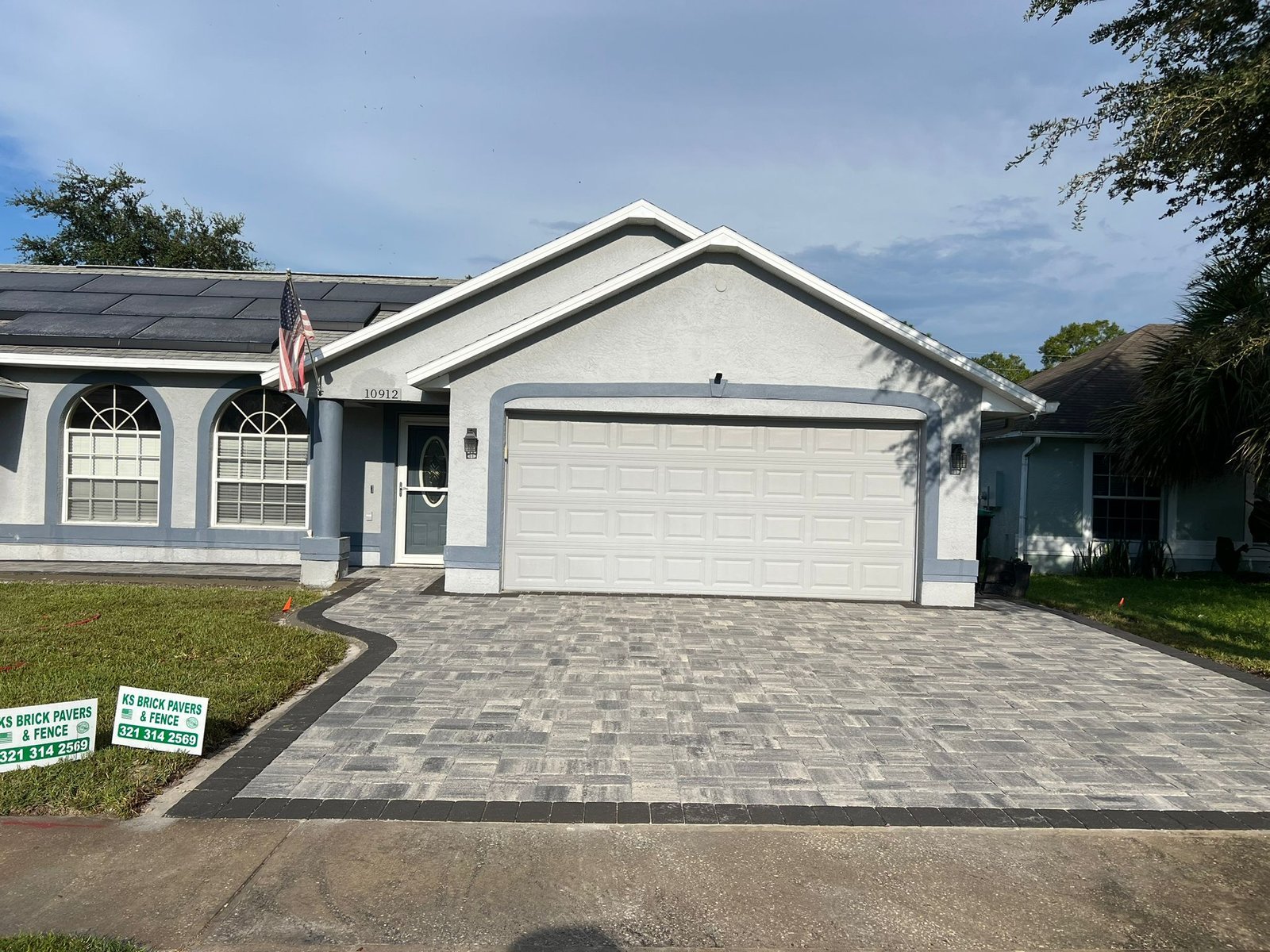
Driveways are the paver project with the most regulation attached, because the last few feet of your driveway are not really yours. Where it meets a public road, the county has an interest in it.
For a residential driveway connecting to a Seminole County road, the county's Development Review Division issues a Residential Driveway Permit. A few specifics from the county's own application:
- The driveway may be up to 18 feet wide, with a 3 foot flare on each side.
- The apron, meaning the section where the driveway meets the roadway, must be concrete or brick paver.
- The permit fee is $45.
- Processing runs about 3 business days.
That apron rule is worth pausing on, because it works in your favor. Brick paver is explicitly an accepted apron material, so a paver driveway can run all the way to the road as one continuous surface instead of stopping awkwardly at a concrete strip.
The 18 foot limit is the one that surprises people. Homeowners planning a wide double or triple driveway sometimes design first and permit second, then have to redraw. Get the width settled before anyone orders material.
Note that this permit applies to access onto a county maintained road. If your address is inside one of the seven city limits, or your driveway ties into a state road, the reviewing authority changes. Part of what we do at quote stage is confirm which agency actually reviews your specific address, so the application goes to the right desk the first time.
(321) 353-7445Get Immediate Service
Timing: Rainy Season, Storm Season and When to Book
Central Florida has two calendars that matter for outdoor construction, and they overlap.
The rainy season runs June through September. Daily afternoon storms do not stop paver work outright, but they compress the workday and they interfere with specific stages. Excavation in saturated ground is messy and compaction results suffer. Anything involving mortar or concrete curing, such as a bond beam, a step, or a wall footing, needs a dry window. Joint sand does not set properly into a wet joint. A competent crew works around all of this by sequencing the wet sensitive stages into the morning, but the honest version is that a summer job has more weather days than a February job.
Hurricane season runs June 1 through November 30, with peak activity from August through October. September is statistically the most active month of the year.
Put those together and the practical advice is simple. If you want a project done before storm season, book it in the winter or early spring. The dry months from October through May average around three inches of rain a month, the ground is workable, and you are not competing with everyone who suddenly wants their outdoor space fixed in June.
This matters even more when the paver work is paired with a fence or a pool barrier. After Ian, demand for outdoor repair work in Seminole County did not stay flat, and permit review queues do not speed up because your project became urgent. A fence permit in unincorporated Seminole County takes 1 to 3 weeks to process on its own, before a single post goes in the ground. Building that review time into your plan is the difference between finishing in spring and starting in August.
One more timing note specific to pavers: a paver surface is repairable in a way a concrete slab is not. If a storm event or a root heaves a section, individual pavers lift out, the base gets corrected, and the same pavers go back down. There is no pour line and no color mismatch. That repairability is a genuine practical advantage in a county that floods.
HOA Approval in Seminole County Communities
Seminole County has a high concentration of planned communities with active homeowner associations. Heathrow alone runs roughly 2,061 homes under the Heathrow Master Association, with around 30 sub associations underneath it. Alaqua Lakes, Magnolia Plantation, Sanctuary and Live Oak Reserve in the Oviedo area operate their own architectural review processes.
If you live in one of these communities, the association review is usually the longest single step in your project timeline, and it is entirely outside the county's process. The two run in parallel and neither one substitutes for the other.
Every association writes its own rules, and we are not going to tell you what yours says. What we will tell you is what the review typically wants to see, so you can gather it early:
- A site plan or survey showing exactly where the new hardscape or fence goes on the lot.
- The material, color and style, often with a physical sample or a manufacturer spec sheet.
- Dimensions and height, particularly for anything vertical like a wall or a fence.
- Sometimes a note on drainage, since associations care about water crossing lot lines.
Our part is straightforward: the HOA submittal is included in the quote, same as the county permit. You should still read your own community's architectural guidelines before you fall in love with a specific paver color, because a rejected color after material has been ordered is an expensive lesson. If your association requires a neighbor sign off or a board meeting date, tell us at quote stage so the schedule reflects reality instead of optimism.
Fence Installation in Seminole County: Permits and Pool Barriers
Fence work and paver work land on the same properties often enough that it is worth covering here. Our team handles the entire process, including submitting plans, paying permit fees and scheduling inspections.
What the county wants for a fence permit
To install a fence in unincorporated Seminole County, you file a Residential or Commercial Permit Application with:
- A site plan or survey showing the fence location, height, style and material.
- A copy of the Property Appraiser record with the legal description of the property.
Processing takes 1 to 3 weeks. Permits and inspections for unincorporated Seminole County are administered by the Development Services Department, Building Division, at 1101 E. First Street, Sanford, FL 32771.
Height and setback rules vary by zoning and by whether you are inside a city limit, so confirm your specific parcel before you buy panels. We verify that as part of the submittal rather than assuming.
Pool barriers, where Seminole County is stricter than the state
This is the detail that catches the most homeowners, especially anyone building a paver pool deck. Florida's Residential Swimming Pool Safety Act sets a statewide floor: every residential pool needs a barrier at least 48 inches tall, measured from the outside ground level.
Unincorporated Seminole County goes further than the state minimum and further than several of the county's own cities. Under the county's pool barrier code:
- The gap between the gate and the ground may be no more than 2 inches.
- Double gates are no longer accepted as a barrier.
- Latch clearance is capped at 1/2 inch.
- Screen doors serving as part of the barrier must open outward, be self closing, and latch at 54 inches from the floor.
If you are pouring a paver pool deck and setting a barrier at the same time, those numbers change where posts land and how the deck gets pitched at the gate. Designing the deck and the barrier together is much cheaper than retrofitting a compliant gate into a finished surface.
Artificial Turf in Seminole County and the 2025 State Rules
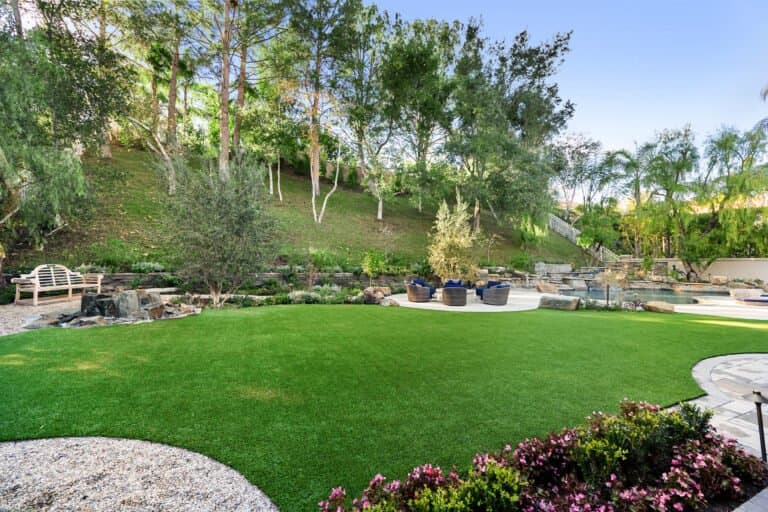
Turf comes up constantly on the same projects as pavers, usually as the answer to a strip of yard that will not grow grass because it sits in shade, holds water, or takes heavy dog traffic.
The regulatory picture got clearer in 2025. Under Florida Statute 125.572, enacted by Chapter 2025-140, the Department of Environmental Protection sets minimum statewide standards for synthetic turf on residential lots up to one acre, covering material, permeability and stormwater drainage. The same law prohibits municipalities and counties from adopting rules that fully ban the installation of turf meeting those standards.
In plain terms: a local government in Florida can regulate how turf is installed on a residential lot of that size, but it cannot simply outlaw compliant turf. If you have been told your area does not allow artificial grass at all, that statement is worth checking against the current statute.
Two caveats, because we would rather set expectations than sell around them. First, the statute governs local government rules. A private homeowners association operates under its own recorded documents, which is a separate question from county or city code, so confirm with your association. Second, permitting requirements for turf still exist at the local level and we verify what applies to your specific parcel before installation rather than guessing.
On the construction side, turf in Central Florida is a drainage product as much as a landscaping one. The base under artificial turf has to move seven inches a month of summer rain through it without going soft. Turf installed over compacted clay or over a poorly graded pad will hold water, smell, and stay soggy for days after a storm. The same base discipline that makes a paver patio last is what makes a turf lawn work.
Maintenance, and How to Vet a Seminole County Contractor
A paver surface installed correctly still needs attention. Joint sand migrates. Weeds find gaps. Organic staining builds up fast in a humid climate with heavy tree cover, and after four months of daily storms a patio that started clean can look tired. Our outdoor maintenance plans exist for the same reason a pool gets serviced: scheduled small work is cheaper than an eventual big repair, and it protects the base that everything else sits on.
If you are collecting quotes, here is what is worth checking.
Confirm the contractor is registered with the county
Seminole County requires contractors to register their state license with the county's Building Division before working or pulling permits locally. A state license alone is not the whole picture here. Ask whether the company is registered with Seminole County specifically. It takes one question and it filters out a surprising amount.
Ask who pulls the permit
If a contractor asks you to pull the permit as the homeowner, understand what that means. The permit holder carries responsibility for the work meeting code. We submit under our own registration.
Get base depth in writing
Not just square footage and paver model. The base spec is the part of the quote you cannot inspect after the fact, which is exactly why it belongs on paper.
Ask about drainage explicitly
Where does the water go, and what is the fall across the finished surface. A contractor who has worked along the St. Johns River side of the county will have a real answer ready.
Ask about the HOA and inspection timeline
Especially in Heathrow, Alaqua Lakes, Live Oak Reserve or Magnolia Plantation, and especially in the run up to hurricane season, when review queues matter more than crew availability.
KS Solutions works across Central Florida, and Seminole is one of several counties we cover. If your project sits near a county line, or you have property in more than one, we also serve Orange County, Volusia County, Lake County, Osceola County and Polk County. Tell us the address and what you are trying to fix, and we will tell you which agency reviews it, what the submittal needs, and what the surface should be doing with the water.